


Tour merch drives significant revenue for working musicians, but managing inventory logistics while on the road creates operational headaches that pull focus from performances. You're selling out in certain markets, running out of sizes mid-tour, or lugging excess inventory from city to city because you miscalculated demand.
This is where contract screen printing for bands becomes a strategic logistics solution rather than just a production method. The right contract partner doesn't just print your designs - they become your mobile supply chain manager, handling restocks, direct-to-venue shipping, and inventory flexibility that keeps merch revenue flowing without the operational burden.
This guide breaks down how touring musicians and band managers can leverage contract printing relationships to streamline merch operations, eliminate inventory carrying costs, and respond to demand in real time. We're talking about the logistics realities that separate profitable tour merchandising from money left on the table.
Before understanding how contract printing solves tour logistics, recognize the problems inherent in traditional merch management.
Most bands start by ordering bulk inventory upfront, then hauling it from venue to venue in vans or trailers. This approach creates multiple problems that compound throughout a tour.
Physical space limitations restrict how much inventory you can carry. Every box of t-shirts means less room for equipment, personal gear, or revenue-generating products. You're constantly making decisions about what to bring and what to leave behind.
Cash flow gets tied up in inventory that might not sell for weeks or months. That capital could fund tour expenses, marketing, or new production runs of designs that are actually moving.
Size distribution becomes a guessing game. You order what seems reasonable, then sell out of mediums and larges while sitting on excess smalls and extra-larges that don't move. By mid-tour, you're turning away buyers because you don't have their size.
When popular items sell out, traditional logistics make restocking difficult. You need to coordinate shipping to a venue you'll be at in the future, time production to arrive before that date, and hope demand continues long enough to justify the restock investment.
This coordination becomes exponentially harder when you're moving between venues every one to three nights. Shipping windows narrow. Venue receiving capabilities vary. Production timelines don't always align with your tour routing.
Different markets respond differently to merch offerings. Your home market crushes it. Festival appearances create demand spikes. Some venues sell lighters; others prefer hoodies and long sleeves.
With fixed inventory, you can't respond to these variations. You're stuck with whatever you loaded at the tour's start, unable to capitalize on unexpected demand or adjust for market preferences.
Someone on your team or crew must manage inventory - tracking what's sold, what remains, securing it overnight, and handling load-in and load-out. This operational burden pulls attention from performances, fan engagement, or other revenue opportunities.
For smaller operations without dedicated merch staff, band members themselves often handle these logistics, which isn't the best use of their time or energy on tour.
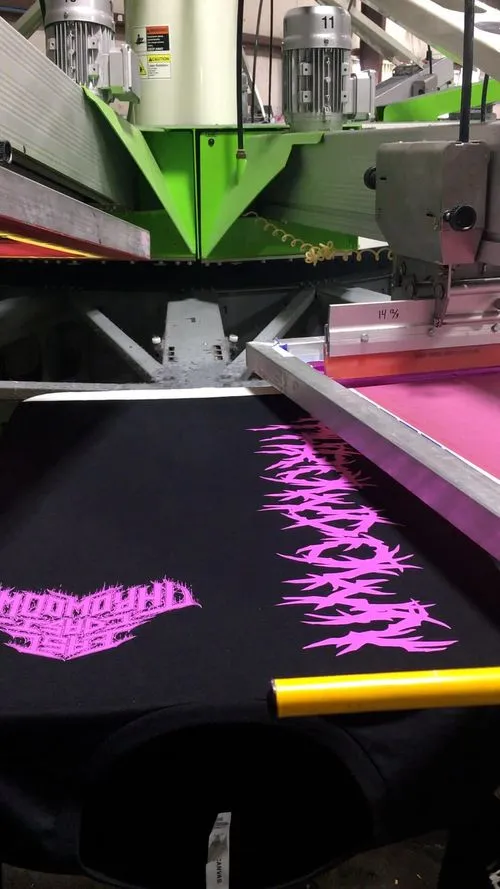
Contract screen printing for bands addresses these operational challenges through flexible production and strategic shipping capabilities.
Contract partners let you order inventory as needed rather than committing to massive upfront purchases. This just-in-time approach provides several advantages for touring operations.
You can start tours with conservative inventory, then reorder proven sellers based on actual demand data. No more guessing about which designs will move or what size distributions make sense.
Cash flow improves because you're not locking up capital in inventory months before the tour starts. Production costs align more closely with actual sales, reducing financial risk.
The logistics game-changer for touring bands is direct-to-venue shipping from contract partners. Instead of carrying all inventory with you, fresh stock ships directly to venues on your tour routing.
This capability requires contract partners with reliable contract screen printing operations that understand timing requirements. Production must be complete and ship with enough buffer time to ensure arrival before load-in.
Venue coordination becomes critical. Your contract partner needs accurate shipping addresses, venue contact information, and clear instructions for package holding. Some venues handle this seamlessly; others need advance communication to ensure proper receiving.
When items sell out, contract printing enables rapid restocking without bringing inventory on the road with you. You identify what sold out, place a restock order, and have it shipped to an upcoming venue.
This flexibility lets you respond to actual market demand rather than pre-tour projections. If a particular design crushes it, reorder heavy. If something isn't moving, don't restock it.
Contract relationships allow you to vary product offerings by market when demand patterns justify it. Festival appearances might warrant special designs or premium items. Home market shows could feature exclusive local designs. Regional preferences can inform garment choices.
This market-specific approach maximizes revenue opportunities without requiring you to carry every possible variation throughout the entire tour.
When contract partners handle production and direct shipping, your touring operation focuses on performance and sales rather than inventory management. Physical space in vehicles increases. Load-in and load-out simplify. Security concerns decrease.
For smaller operations, this reduction in logistics complexity can be the difference between economically viable touring and operations that drain resources.
Not all contract printers can support touring band logistics effectively. Specific capabilities and operational standards matter.
Tour schedules don't flex. If inventory doesn't arrive before load-in, you've lost sales for that venue. This makes production timing reliability the most critical factor in partner evaluation.
Ask potential partners about their typical production timelines for the types of orders you'll be placing. Understand what they consider realistic lead times and whether rush production capabilities exist for unexpected situations.
Test reliability early. Place initial orders with comfortable timing buffers to evaluate whether they consistently meet commitments before trusting them with tight tour deadlines.
When you're on the road, quick communication becomes essential. You need partners who respond rapidly to questions, provide production updates without constant follow-up, and address issues proactively.
Evaluate communication patterns during your vetting process. Slow responses or difficult coordination during initial orders will only worsen under tour pressure.
Quality issues create problems that compound on tour. Returns or exchanges become nearly impossible when you're moving between venues. Unhappy fans share their disappointment on social media, damaging your reputation.
Quality consistency requires systematic production processes and quality control. Ask partners about their QC procedures, defect rates, and how they handle quality issues.
Review samples carefully and insist on consistent execution across reorders. The screen printing services quality you see on initial samples should match full production runs.
Tour merch represents your brand at every venue. Professional finishing details - custom neck labels, hang tags, proper folding, and packaging - create a premium presentation that justifies higher price points.
Evaluate potential partners' apparel finishing services capabilities. Can they provide the complete retail-ready package that supports your merchandising goals?
Finishing quality matters, especially for touring bands, because presentation directly impacts perceived value and sales conversion at merch tables.
Tours create unexpected situations. Venue addresses change. Shipping timelines compress. Design tweaks become necessary. You need contract partners who approach problems collaboratively rather than rigidly.
Assess flexibility during initial interactions. Partners who work with you to solve problems during vetting will continue that approach throughout your tour.
While you want partners who can ship to any venue regardless of location, understanding their standard shipping regions and capabilities helps plan logistics effectively.
Some partners have optimized shipping costs and timelines to certain regions. This knowledge helps you schedule restocks strategically and manage shipping budgets.
Strategic planning transforms contract printing from a production service into a tour logistics advantage.
Start with a conservative inventory for the tour opening. Order enough to stock your merch table properly without overcommitting to quantities that might not move.
Use historical data if available. Which designs sold best previously? What size distributions made sense? Previous tour performance provides valuable planning guidance.
For new designs or first tours, lean toward smaller initial orders with planned restocks based on actual performance. This approach reduces risk while maintaining supply.
Define clear criteria for when to reorder. Many successful touring operations reorder when inventory drops to a certain percentage of capacity or when specific designs sell out.
Build restock lead time into your triggers. If production and shipping require a certain timeframe, initiate reorders before complete sellouts to maintain inventory continuity.
Create a systematic process for communicating venue information to your contract partner. Develop templates that include venue name, shipping address, load-in date and time, venue contact information, and any special receiving instructions.
Send this information with enough advance notice that production and shipping can occur without rush fees or tight timing. Successful operations provide venue details well in advance of show dates to allow comfortable production and shipping windows.
Tour logistics require buffers that account for potential delays. Shipping takes longer than estimated. Production occasionally runs into unexpected challenges. Venues sometimes receive packages later than expected.
Build conservative timing into your logistics planning. It's better to have inventory arrive early than risk missing show dates due to tight scheduling.
Understand the complete cost structure for contract printing on tour. Factor in production costs, shipping expenses, potential rush fees, and finishing services when budgeting.
While contract printing often provides better economics than carrying a massive inventory, individual order costs may be higher than bulk pricing. The operational advantages and reduced carrying costs typically justify these differences for touring applications.
Certain design approaches work better for contract printing logistics and touring applications.
Designs with broad appeal across different markets and demographics reduce complexity. When the same designs sell well everywhere, logistics simplify and inventory management becomes more straightforward.
Market-specific designs create operational complexity - more SKUs to track, more complex reordering, and more potential for excess inventory. Reserve market-specific offerings for situations where demand clearly justifies the added complexity.
Limiting garment colors reduces production complexity and often lowers costs. Many successful touring bands build strong merch programs around black and white shirts with strategic accent colors.
This approach simplifies restocking decisions and reduces the number of variables in inventory management.
Different printing techniques affect production timelines, costs, and minimum order quantities. Understanding these relationships helps you make strategic design decisions.
Simulated process screen printing creates photorealistic artwork but typically requires higher minimums. Simple spot color designs often have lower minimums and faster turnaround, making them ideal for tour restocking.
Discharge screen printing creates incredibly soft prints on dark garments but requires specific fabric types and has certain timing requirements. Understanding these constraints helps you plan appropriately.
Professional finishing elevates perceived value and supports premium pricing. Custom neck labels, hang tags, and proper packaging create a retail-quality presentation that fans expect from established artists.
These finishing details don't just look good - they communicate professionalism and justify the price points that make tour merchandising profitable.
Successful touring merchandising requires active contract relationship management while on the road.
Maintain regular contact with your contract partner throughout the tour. Provide sales updates, communicate which items are moving and which aren't, and discuss upcoming restocking needs before they become urgent.
This ongoing communication helps partners anticipate your needs and plan production capacity accordingly.
Track sales data religiously. Which designs sell best? What size distributions are you actually seeing? Which venues or markets move the most merchandise?
This data informs restocking decisions and helps you optimize inventory for the remainder of the tour. Share relevant insights with your contract partner to improve their understanding of your needs.
When issues arise - shipping delays, quality concerns, venue receiving problems - address them quickly and collaboratively. Document problems for learning purposes, but focus on solutions rather than blame.
Strong contract relationships withstand occasional problems when both parties approach resolution constructively.
Use each tour as a learning opportunity. What worked well with your contract arrangement? What could improve? Which designs were most successful? What timing or logistics issues emerged?
Document these insights to improve planning for future tours. Share feedback with your contract partner to strengthen the relationship and improve future performance.
Understanding the financial implications helps you make informed decisions about contract printing for tour logistics.
Compare contract printing costs against traditional bulk purchasing on a total cost basis. Include inventory carrying costs, shipping expenses to the tour start, physical space costs, and operational burden when evaluating economics.
Contract printing often provides better overall economics even when per-unit costs appear higher because you're eliminating high indirect costs.
Contract printing's flexibility lets you adjust pricing strategy based on market response. If designs are selling strongly, you can maintain higher price points. If movement is slower, you can adjust without being locked into massive inventory investments.
This pricing flexibility optimizes revenue across different markets and throughout the tour lifecycle.
The biggest economic advantage of contract printing for tours? Never running out of popular items. Lost sales from stockouts often exceed any cost differences between production methods.
When fans want to buy but you don't have their size or preferred design, you've lost revenue that can never be recovered. Contract printing's restocking flexibility minimizes these lost opportunities.
Learn from these frequent touring merch logistics mistakes.
The most common mistake is underestimating how much advance notice contract partners need for production and shipping. What seems like plenty of time often isn't when you factor in production schedules, shipping transit, and venue receiving.
Build conservative buffers into all timing planning. Better to have inventory arrive early than miss show dates.
Inadequate venue communication causes shipping problems. Incomplete addresses, wrong contact information, or insufficient advance notice to venue staff create receiving issues.
Develop systematic venue communication processes and provide complete information with appropriate advance notice.
Bands sometimes continue ordering the same designs and quantities throughout tours without analyzing what's actually selling. This ignores the contract printing advantage—the ability to respond to actual demand.
Track sales religiously and adjust restocking accordingly. Let data drive inventory decisions.
Too many designs, colors, and variations create operational complexity that overwhelms tour logistics. Start with a focused offering and expand only when demand clearly justifies additional complexity.
Simplicity improves execution and often drives better overall results than extensive but poorly managed product lines.
Contract screen printing for bands transforms tour merchandising from an operational burden into a flexible, responsive revenue stream. By partnering with reliable contract printers who understand touring logistics, you eliminate inventory carrying costs, respond to market demand in real-time, and focus on performances rather than merch management.
Ready to streamline your tour merch supply chain? Contact our contract printing team to discuss how we support touring operations with reliable production, direct-to-venue shipping, and finishing services that elevate your merchandise program. Or explore our contract printing services to learn more about our approach to tour logistics.
Production and shipping timelines vary based on order complexity and destination, but plan for an adequate lead time that accounts for production, shipping transit, and venue receiving. For standard orders, providing venue information and placing orders well in advance ensures comfortable timing. For complex designs or specialty techniques, additional time may be required. The best approach is to discuss your specific tour routing and timeline with your contract partner early so they can recommend appropriate scheduling. Building buffer time into your planning prevents stress and ensures inventory arrives before load-in. Rush production options exist but typically carry premium pricing and may limit design or finishing options.
Yes, direct-to-venue shipping is one of the primary advantages of contract printing for touring bands. This capability requires providing accurate venue information, including complete shipping addresses, load-in dates, venue contact details, and any special receiving instructions. Different venues have varying receiving capabilities and procedures, so advance communication helps ensure smooth delivery. Some venues handle merch deliveries routinely, while others need advance notice to coordinate receiving. Working with your contract partner to establish clear communication protocols for venue shipping ensures reliable delivery throughout your tour routing. This approach eliminates the need to carry all inventory on the road and enables mid-tour restocking based on actual demand.
Minimum order quantities depend on printing technique and design complexity. For straightforward designs, minimums typically start at moderate quantities that make sense for restocking purposes. More complex printing techniques like simulated process for photorealistic artwork generally require higher minimums due to setup and production requirements. For bands needing smaller quantities with design complexity, heat transfer options like DTF provide lower minimums while maintaining quality above basic alternatives. When evaluating contract partners, understand their minimum requirements for the specific printing techniques your designs require. This knowledge helps you plan initial inventory and restocking strategies that align with both your budget and the partner's production capabilities.
Quality assurance before shipping is critical for touring applications since returns or exchanges become extremely difficult once you're on the road. Reliable contract partners implement systematic quality control processes that catch issues before products leave their facility. When establishing contract relationships, discuss quality standards, sample approval processes, and how problems are handled. Many successful touring operations request samples before full production runs, especially for new designs or first-time partnerships. If quality issues do occur with delivered products, strong contract partners work collaboratively to resolve situations quickly, often by rushing replacement inventory to upcoming venues. The key is choosing partners with proven quality control systems and responsive problem-solving approaches.
Contract partners need complete and accurate information for successful venue delivery. Essential details include venue name and any alternate facility names, complete shipping address including loading dock or specific receiving location, load-in date and time when the band will be at the venue, venue contact person and phone number for shipping coordination, and any special receiving instructions or restrictions. Providing this information with adequate advance notice allows proper production scheduling and shipping coordination. Many touring operations develop templates that include all necessary details and send them to contract partners as soon as tour dates are confirmed. The more complete and accurate your venue information, the smoother the direct shipping process operates throughout your tour.

