


So you've been running your clothing brand on print-on-demand for a while. Sales are coming in, your designs are getting traction, and you're ready to level up. But now you're staring at minimum order quantities, ink choices, and finishing options that all feel like a foreign language.
Here's the thing about making the jump to bulk production: it's not just about ordering more shirts. It's about making strategic decisions that affect your cash flow, product quality, and brand positioning. Get it right, and you scale smoothly. Get it wrong, and you're sitting on inventory that doesn't sell or dealing with quality issues that tank your reputation.
This guide breaks down the production decisions that actually matter when you're launching or scaling a clothing brand. We're talking about the stuff that impacts your bottom line and customer experience - not generic "this is how screen printing works" content you've already read a dozen times.
When you're producing apparel for a clothing brand, you've got options. But not all of them make sense for every situation.
Let's get one thing out of the way first: we're not talking about print-on-demand services where you're paying premium prices for single units. You're past that stage. We're also not covering methods that don't scale well for clothing brands (spoiler: some decoration techniques work great for promotional products but are terrible for fashion brands).
Screen printing for clothing brands has been the go-to production method for decades, and there's a reason why. It produces durable, high-quality prints that hold up to repeated washing and wearing. The colors are vibrant, the feel can be incredibly soft when done right, and the per-piece cost decreases as your order quantity increases.
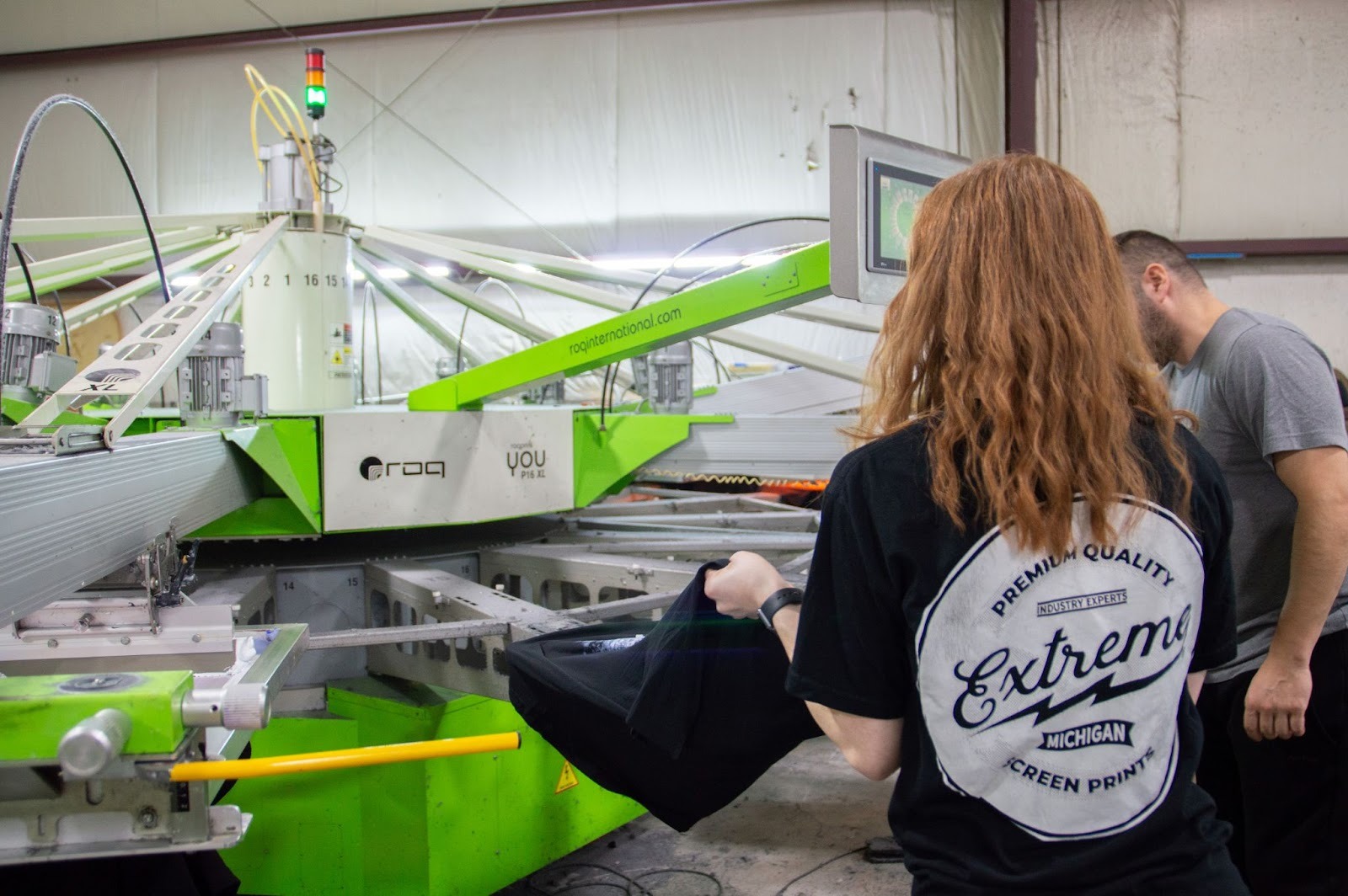
Screen printing services work by pushing ink through mesh screens onto fabric. Each color in your design requires its own screen, which is why you'll see minimums based on color count. The more colors you use, the more setup is involved.
For clothing brands, screen printing makes sense when you're ordering at least 50 pieces of a design (for simpler artwork with fewer than 7 colors) or 100 pieces for more complex work. These minimums exist because there's setup involved, regardless of whether you're printing 10 shirts or 100 - screens need to be made, colors need to be mixed, and presses need to be configured.
The payoff? Once setup is complete, the actual printing is fast and cost-effective. You get consistent quality across all units, which matters when customers are buying from your brand repeatedly.
Direct-to-film (DTF) custom heat transfers offer a different approach. With a 15-piece minimum, they bridge the gap between print-on-demand and bulk screen printing.
DTF works by printing your full-color design onto a special film, then heat-pressing that film onto garments. It handles complex, multi-color artwork without the per-color setup costs of screen printing.
Here's when DTF makes strategic sense for clothing brands:
You're testing a new design before committing to larger screen-printed runs. You want to validate market interest with minimal inventory risk. Spending money on 15 units to test is smarter than gambling on 100 units of an untested design.
You're launching with multiple designs and can't afford 50-100 units of each one yet. If you're dropping a collection with 5 different designs, ordering 15 units of each (75 total pieces) gives you variety without a massive upfront investment.
You need a limited-edition drop with intentionally low quantities. Some brands use scarcity as part of their marketing strategy. DTF lets you do genuine small-batch releases.
The trade-off is between feel and durability. DTF transfers have a different hand feel than screen printing - a more noticeable texture on the fabric. They're durable enough for fashion brands, but screen printing typically outlasts them with heavy wear.
Your production method should match your current business stage and goals.
Starting out or testing designs? Use DTF for your first few releases. It lets you validate designs and build a customer base without tying up cash in inventory.
Validated your designs and have consistent sellers? Transition those proven designs to screen printing. The per-piece cost is lower, the quality is higher, and you can maintain inventory of your bestsellers.
Launching a full collection? Mix both methods. Screen print the core designs that you'll reorder frequently, and use DTF for limited-edition or specialty pieces.
Minimum order quantities feel restrictive when you're used to printing one-at-a-time. But understanding the tiers helps you make smarter inventory decisions.
This tier works for brands in the validation phase. You've got designs that look great on mockups, but you haven't proven they'll sell. Ordering 15 units per design lets you:
Test the actual market response with real customers wearing your product. Mockups and hype posts are one thing. Actual sales data is another.
Shoot professional content with real products. Your marketing immediately looks more legitimate when you're shooting on real garments instead of relying solely on digital mockups.
Fulfill pre-orders without gambling on unsold inventory. If you've got 8-12 pre-orders on a design, ordering 15 units makes sense. You fulfill your commitments and have a few extras for content or last-minute sales.
Do the math on cash flow. If you're ordering 15 units of 3 designs, that's 45 total pieces. Even with finishing costs, you're investing less than you would on 100 units of a single screen-printed design, making it easier to test multiple concepts without major capital commitment.
This is where most clothing brands find their sweet spot once they've validated designs. Ordering 50 units of a proven design makes sense when:
You've already sold through your test batch and know there's demand. If your 15-unit DTF test sold out in two weeks, ordering 50 screen-printed units is a logical next step.
You're ready for a design to become part of your core lineup. Some designs are clearly winners - they fit your brand aesthetic perfectly, and customers consistently ask about them. These deserve screen-printed inventory.
You need better unit economics to hit your margin targets. Screen printing at 50 units typically costs less per piece than DTF at 15 units, which improves your margins or lets you price more competitively.
You can handle the inventory investment without straining cash flow. Fifty units of a design with proper size distribution (assuming you're offering S-XL) means you've got depth to handle reorders without constantly going back to production.
When you get into high-color-count artwork (7+ colors) or photorealistic prints using simulated process screen printing, minimums typically increase to 100 pieces. This tier makes sense when:
You've got a hero design that defines your brand. Every clothing brand has that one design that sells consistently and represents what the brand is about. These deserve the investment in 100-unit production runs.
You're launching with confidence based on strong pre-order numbers. If you've got 40+ pre-orders on a design, jumping to 100 units gives you fulfillment inventory plus stock for ongoing sales.
You're working with designs that require the quality that only a simulated process can deliver. If your brand aesthetic is built around detailed, photorealistic artwork, you need the production quality that matches your positioning.
However many units you order, think through the size distribution carefully. Don't just order 20 smalls, 20 mediums, 20 larges, 20 XLs and call it good.
Look at your past sales data if you have it. Most brands skew toward medium and large, with fewer smalls and XLs. A typical distribution might be 15% small, 35% medium, 35% large, and 15% XL for general streetwear aesthetics.
Consider your target customer. If you're designing specifically for women's fit preferences, your size distribution should reflect that. If your brand leans toward oversized fits, expect to sell more larges and XLs.
The ink type you choose affects how your garments look, feel, and align with your brand positioning. This isn't just a technical decision - it's a brand identity decision.
Water based screen printing produces prints that become part of the fabric rather than sitting on top of it. The ink soaks into the fibers, creating an incredibly soft hand feel that many customers associate with vintage or premium garments.
This technique works best for brands with these characteristics:
Your aesthetic leans vintage, worn-in, or heritage-inspired. Water-based inks create that authentic vintage concert tee feel that fashion-forward customers love.
Your designs use muted, earthy tones rather than bright, punchy colors. Water-based inks have a softer color appearance that fits certain brand aesthetics perfectly.
You're positioning at a premium price point where hand feel matters. Customers paying high prices for apparel expect soft, comfortable garments. Water-based printing delivers that tactile quality.
Your target customer values sustainability messaging. Water-based inks contain fewer plastics and harsh chemicals than other options, which resonates with environmentally conscious buyers.
The limitation? Water-based inks work best on 100% cotton and natural fiber garments in lighter colors. They struggle on dark fabrics and synthetic blends.
Discharge screen printing removes the dye from colored fabric, then replaces it with your design colors. The result is incredibly soft prints on dark garments - you get the hand feel of water-based printing with the ability to work on black, navy, and other dark colors.
Discharge makes sense for clothing brands when:
Your designs need to be soft, but you're printing on dark garments. Black tees are a staple for many streetwear and fashion brands. Discharge lets you maintain that soft feel customers expect.
You want a vintage, lived-in look from day one. Discharge creates subtle, muted tones that look like they've been washed a hundred times - in a good way.
Your brand aesthetic favors understated rather than bold, vibrant graphics. Discharge produces more muted, sophisticated color tones than plastisol.
The catch? Discharge only works on 100% cotton (or very high cotton content blends), and color results can vary based on the original garment color. It's also not predictable on certain garment colors like royal blue, purple, or forest green.
Plastisol screen printing uses PVC-based inks that sit on top of the fabric. It's the most versatile option and the industry standard for a reason - it works on any fabric color, produces vibrant colors, and creates durable prints that last.
Plastisol fits clothing brands that need:
Bright, saturated colors that pop. If your brand aesthetic is bold graphics with vivid colors, plastisol delivers that visual impact.
Consistency across different garment colors and types. Plastisol works on cotton, poly blends, dark colors, light colors - everything. This consistency matters when you're offering the same design on multiple garment options.
Maximum durability for designs that customers will wear repeatedly. The prints hold up to heavy washing and wearing, which matters for brands building customer loyalty through product quality.
The ability to print complex, multi-color artwork accurately. Simulated process screen printing for photorealistic designs uses plastisol inks because of their opacity and color accuracy.
Modern plastisol printing can achieve a soft hand feel when done correctly, so don't assume plastisol automatically means a heavy, stiff print. Quality printers know how to work with plastisol to create soft results.
Hybrid printing combines discharge underbase with plastisol top colors. You get a soft hand feel from the discharge base plus vibrant, opaque colors from the plastisol layers.
This technique works for brands with designs that need both softness and color vibrancy on dark garments. It's particularly effective for high-color-count artwork on black or dark tees where you want that premium, soft feel but also need colors to stay true and vibrant.
The limitation is that the hybrid requires 100% cotton garments and works best on specific dark colors. It's also generally more expensive than single-ink-type printing.
Here's where a lot of clothing brands mess up their first production run. They focus entirely on getting the print right and completely overlook the finishing details that separate retail-ready products from amateur-hour merch.
When someone buys from your brand, the unboxing experience and first impression matter. If your shirt arrives wrinkled, with a manufacturer's tag still in it, in a generic plastic bag, you're not presenting as a serious brand - even if the print quality is excellent.
Professional apparel finishing services include the details that make products retail-ready from the moment they leave production.
Nothing screams "not a real brand" like leaving the manufacturer's Gildan or Bella+Canvas tag in your shirts. Your customers don't want to wear someone else's branding - they want to wear yours.
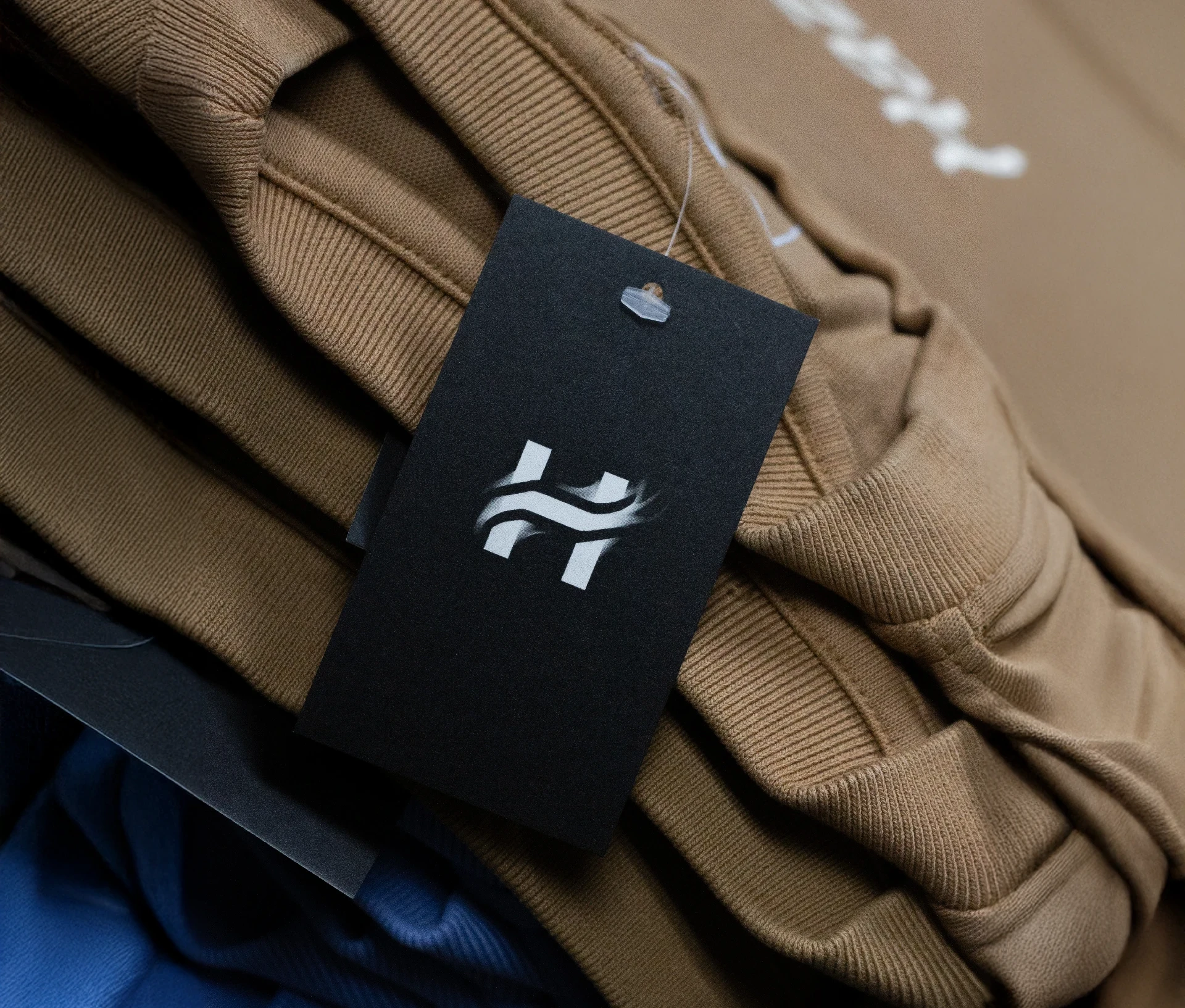
Custom printed neck tags replace the manufacturer label with your brand name, logo, and size information. This simple detail makes a huge difference in how your brand is perceived.
For emerging brands, printed tags are the most cost-effective option. They're screen printed directly onto the neck area of the garment, providing a clean, soft label that doesn't itch or need to be cut out.
As your brand grows and you increase order volumes, you might transition to woven labels that get sewn in. But printed tags are perfect for brands in the 50-200 unit order range.
Hem tags sewn into the side seam at the bottom of the garment serve two purposes: they provide care instructions and add another branding touchpoint.
These tags can include your logo, website, washing instructions, and sizing information. They're small details that add legitimacy to your product - customers expect to see them on retail clothing.
Hang tags attached to garments provide another opportunity for brand storytelling. They can include:
Quality hang tags signal to customers that your brand takes presentation seriously. They also make your products more retail-ready if you're pursuing boutique placements or pop-up shop opportunities.
Individual poly bags keep garments clean, protected, and ready for sale. When products arrive individually bagged, they look professional and ready to ship directly to customers or display in a retail environment.
This matters more than you might think. If you're fulfilling orders yourself, pulling a pre-bagged, tagged garment and dropping it into a shipping mailer is way easier than handling loose inventory. If you're selling wholesale, buyers expect products to arrive retail-ready.
Beyond just bagging, professional fold-and-bag services ensure consistent presentation. Every garment is folded the same way, creating a uniform look whether you're displaying products at a market or photographing them for your website.
This consistency is what separates established brands from newcomers. Your products look like they belong on store shelves because they're packaged like products that belong on store shelves.
As your brand grows, you might reach a point where working with contract screen printing services makes sense. This is when you're supplying your own garments, and the printer is just handling the printing and finishing - not providing the blanks.
Contract printing typically makes sense for brands that have reached certain milestones:
You're ordering large enough quantities that sourcing your own garments offers cost advantages. At higher volumes, buying garments directly from distributors can be cheaper than paying a printer's markup.
You have specific garment requirements that aren't in standard catalogs. Maybe you've found a specific manufacturer or unique garment that fits your brand aesthetic perfectly.
You're working with multiple printers for different services. Some brands use one printer for screen printing and another for embroidery and handle fulfillment themselves or through a third party.
Contract printing requires understanding tiered pricing structures and having processes in place for shipping garments to your printer, coordinating production schedules, and managing quality control.
Blind shipping means your printer ships orders directly to your customers without any branding or paperwork that identifies the printer. To the customer, it looks like the order came straight from your brand.
This service is crucial for direct-to-consumer brands that want to maintain the perception of having their own production facilities. Your customer never needs to know you're working with a production partner - they just receive their order with your branding and packaging.
Quality printers offering blind shipping will include unbranded packing slips (or no packing slips at all, depending on your preference) and ship from generic return addresses that don't identify them as a printing company.
One of the biggest frustrations for clothing brand owners is not being able to get clear, accurate pricing without going through lengthy quote request processes.
Traditional screen printing shops make you fill out a form with your project details, then wait 24-48 hours for a quote. You might get a range instead of specific pricing. Set-up fees and finishing costs might not be clearly broken out. You're left guessing what your actual cost per unit will be.
This lack of transparency makes it hard to make informed decisions about:
Modern production partners offer instant online quote builders that let you see real pricing immediately. You can select your garment, choose your print complexity, add finishing options, and see the total cost broken down clearly.
This transparency helps you make better business decisions. You can experiment with different scenarios:
What if you order 75 units instead of 50? What if you upgrade to a premium garment? What if you add custom hang tags? You see exactly how each decision affects your costs.
Some printers charge setup fees separately. Others build setup costs into the per-piece pricing. Neither approach is inherently wrong, but you need to understand total costs to compare options accurately.
Setup costs cover screen making, color mixing, press configuration, and any artwork preparation. These are one-time costs per design regardless of quantity ordered.
Per-piece costs cover the actual garment, ink, printing labor, and finishing. These multiply based on quantity.
When comparing quotes, always calculate your total cost per unit, including all fees. A printer charging lower per-piece rates but high setup fees might actually be more expensive than one with higher per-piece rates and no setup fees - or vice versa.
When you're running a clothing brand, timing matters. You might be coordinating a product drop, planning a market appearance, or fulfilling pre-orders with deadlines.
Working with production partners who respond quickly to inquiries and questions makes your life easier. Look for printers who commit to response time standards - knowing you'll hear back within a few hours rather than a few days helps you plan and move faster.
Quality consistency across orders matters more for clothing brands than almost any other customer segment. Your customers are buying multiple items over time, and they expect the same experience every time.
When you reorder a design, the colors need to match your previous run. This requires printers to use standardized color systems (like Pantone) and maintain detailed records of which colors were mixed for each design.
For clothing brands, color consistency is part of your brand identity. If your signature design comes out in different shades on different production runs, customers notice and lose confidence in your brand.
Your design should be positioned consistently across all sizes and garments. A print that's perfectly centered on a medium shouldn't be off-center on an XL - but this happens when printers don't have proper processes for different size placements.
Quality printers provide artwork templates for different sizes and ensure print placement is accurate across your entire run.
Crooked neck tags, poorly attached hang tags, or inconsistent folding all signal a lack of quality control. Professional production partners inspect garments before finishing and again before shipping to catch these issues.
For clothing brands, this quality control is essential. You're building customer loyalty through product quality and presentation - finishing mistakes undermine that effort.
When you're planning your first bulk production run, here's how to think through the key decisions:
Don't try to launch with 8 different designs right away. Pick 2-3 designs you're most confident about and start there. You can always expand your line after you've validated initial designs and built some cash flow.
If you've been running print-on-demand and have sales data, start with whatever's already selling. If you're launching fresh, choose the designs that best represent your brand aesthetic and would photograph well for your initial marketing push.
If you're testing 2-3 designs and want 15-20 units of each to start, use DTF. Total investment is manageable, and you get variety.
If you've got one hero design you're confident about and want to go deeper on inventory, order 50-100 screen-printed units. The per-unit cost will be lower, and quality will be higher.
If you're doing both - maybe one proven design at 100 units screen printed plus two test designs at 15 units each via DTF - that's a smart mixed approach.
If you're purely direct-to-consumer online, focus on individual poly bagging and custom neck tags. These are the finishing elements customers experience directly.
If you're pursuing wholesale or doing pop-ups and markets, add hang tags. Buyers and in-person customers expect that retail presentation.
If you're doing both channels, invest in the full finishing package from the start. It's harder to retrofit finishing later than to include it from your first production run.
Your first production run with a new printer will take longer than subsequent reorders. There's back-and-forth on artwork approval, mockup reviews, and confirming all the details.
Standard production timelines are typically 10-12 business days, but for first orders, plan for 3-4 weeks total to account for communication time, artwork adjustments, and approval processes.
This matters for launch planning. If you're building hype for a release date, make sure you've started production with enough buffer that delays don't leave you scrambling or missing your launch window.
Choosing who to work with for production is one of those decisions that affects everything else. Get it right, and you have a reliable partner who helps you scale. Get it wrong and you're dealing with quality issues, communication problems, and fulfillment headaches.
Technical capabilities matching your design style: If your brand aesthetic is photorealistic artwork, make sure they excel at simulated process printing. If you're doing soft, vintage vibes, they need expertise in water-based or discharge methods.
Finishing services in-house: Working with a shop that handles everything from printing to tagging to bagging means fewer coordination headaches and faster turnaround.
Transparent pricing you can see upfront: Being able to price options yourself without waiting for quotes helps you make faster decisions and plan inventory better.
Minimum order quantities that match your business stage: If you're starting with 50-unit orders, you need a printer comfortable at that scale. If you're testing with 15-unit DTF runs first, make sure they offer that option.
Communication standards you can rely on: Quick response times to questions and proactive updates about your order status matter when you're coordinating launches and fulfillment.
Screen printing for clothing brands requires understanding the strategic decisions that affect your inventory investment, product quality, and brand presentation. From choosing between DTF and screen printing based on your quantities, to selecting inks that match your brand aesthetic, to ensuring retail-ready finishing on every order - these details separate successful clothing brands from those that struggle to scale.
The right production partner doesn't just print your designs. They help you make informed decisions about minimums, finishing, and fulfillment that set your brand up for sustainable growth.
Ready to bring your clothing line to life with a production partner who understands small brands? Use our instant online quote builder to see transparent pricing for your first production run - no setup fees, clear pricing, and get answers to your questions from our team.
Minimum order quantities for screen printing depend on design complexity. For designs with fewer than 7 colors, minimums typically start at 50 pieces per design. For complex artwork with 7 or more colors (like photorealistic prints using simulated process), minimums usually increase to 100 pieces. These minimums exist because screen printing involves setup time for making screens, mixing colors, and configuring presses, regardless of quantity. For smaller quantities, DTF heat transfers offer a 15-piece minimum, which works well for testing designs before committing to larger screen-printed runs.
Ink selection depends on your brand aesthetic and garment choices. Water-based inks create incredibly soft, vintage-feeling prints that work best on light-colored, 100% cotton garments—perfect for brands with heritage or premium positioning. Discharge inks remove fabric dye to create soft prints on dark garments, producing muted, lived-in tones ideal for understated streetwear aesthetics. Plastisol inks work on any fabric color and content, producing vibrant, durable prints with excellent color accuracy - best for brands needing bright graphics or consistency across different garment types. Hybrid printing combines a discharge underbase with plastisol top colors for both softness and vibrancy on dark cotton garments.
Retail-ready finishing includes several components that separate professional brands from amateur operations. Custom printed neck tags replace manufacturer labels with your branding, creating a legitimate product presentation. Hem tags sewn into the side seam provide care instructions and additional branding touchpoints. Hang tags attached to garments allow for brand storytelling and create shelf appeal for wholesale or retail display. Individual polybagging keeps products clean and protected while providing a professional presentation. Fold-and-bag services ensure consistent product appearance across all units. These finishing elements make products ready to ship directly to customers or display in retail environments without additional handling.
Yes, this service is called blind shipping, and many production partners offer it for direct-to-consumer clothing brands. Blind shipping means orders ship from the printer directly to your customers without any branding or paperwork identifying the printing company. To customers, it appears the order came directly from your brand. Quality printers offering blind shipping use unbranded packing slips and generic return addresses. This service is particularly valuable for clothing brands that want to maintain the perception of handling their own fulfillment while actually working with production partners. Contract screen printing services often include blind shipping options for established brands with consistent order volumes.
Standard production timelines are typically 10-12 business days for most screen printing orders once artwork is approved and the order is confirmed. However, first-time orders with a new production partner usually take longer due to artwork approval processes, mockup reviews, and detail confirmation - plan for 3-4 weeks total for your first order to account for communication and approval time. Rush services are available but cost extra. Complex orders requiring specialty printing techniques or extensive finishing may require additional production time. Successful clothing brands plan launches with enough timeline buffer to handle potential delays without missing release dates or disappointing customers with late deliveries.

